
How San Angelo’s West Texas Dust Affects Your Carpet Lifespan
San Angelo’s West Texas dust significantly shortens carpet lifespan by embedding abrasive silica particles deep into carpet fibers, causing accelerated fiber degradation, premature matting, and persistent discoloration that routine vacuuming cannot fully address. In the Concho Valley region, where dry winds, low humidity, and exposed caliche soil create near-constant airborne particulate, carpets in unprotected homes can lose years of functional life compared to carpets maintained in less dusty climates. This is why regular carpet cleaning in San Angelo is not just a comfort decision , it is a necessary part of protecting your flooring investment against conditions that most other climates simply do not produce. The good news is that understanding exactly how this process works gives homeowners a clear path to slowing it down.
Why San Angelo’s Environment Is Unusually Hard on Interior Carpets
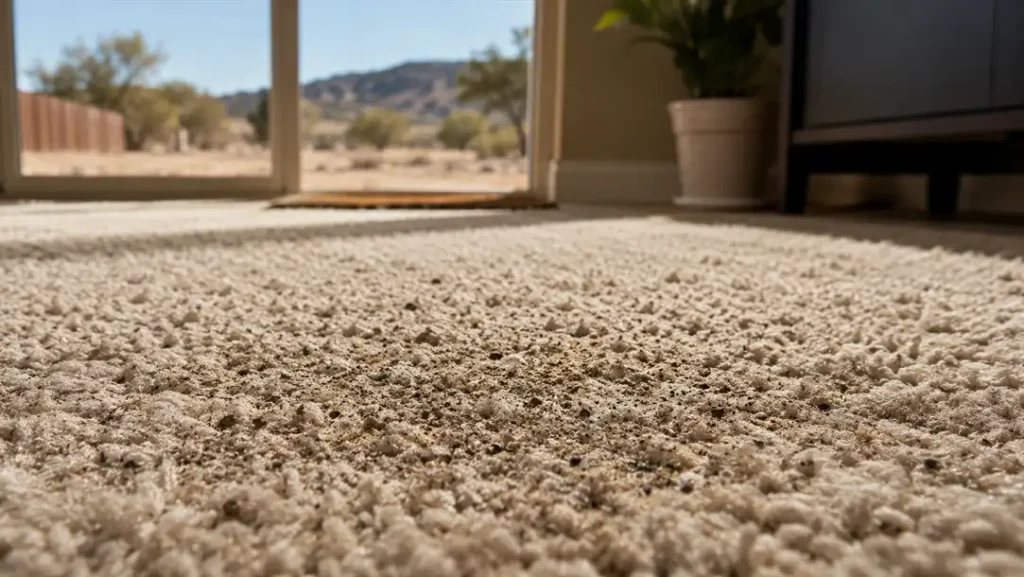
To understand the damage, you first need to understand the source. San Angelo sits in Tom Green County at the edge of the Edwards Plateau, where the landscape transitions from mesquite scrubland to open range and semi-arid grassland. The region receives an average of just under 20 inches of rainfall per year, leaving the soil dry and loosely bound for long stretches at a time. When the Concho Valley’s seasonal winds pick up, particularly during spring and early summer across communities including Ballinger and Christoval — that soil becomes airborne and finds its way into homes throughout the region.
What makes West Texas dust especially problematic for carpet is its mineral composition. The dominant particulate in this region includes silica, caliche, and fine clay minerals derived from the region’s geology. Silica, in particular, is exceptionally abrasive. It ranks a 7 on the Mohs hardness scale, which means it is harder than most carpet fibers, including nylon, polyester, and olefin. Every time a foot presses down on carpet that contains embedded silica particles, those particles act like microscopic sandpaper against the fiber strands, cutting into the surface texture and weakening the structural integrity of the yarn over time.
This is not a slow, theoretical process. Carpet manufacturers and fiber scientists have documented fiber degradation from abrasive particulate as one of the leading causes of premature carpet aging, ranking alongside UV exposure and chemical damage. In a city like San Angelo, where fine mineral dust enters homes through gaps around doors and windows, HVAC systems, and foot traffic, the accumulation is continuous rather than seasonal.
The Science Behind How Dust Destroys Carpet Fibers
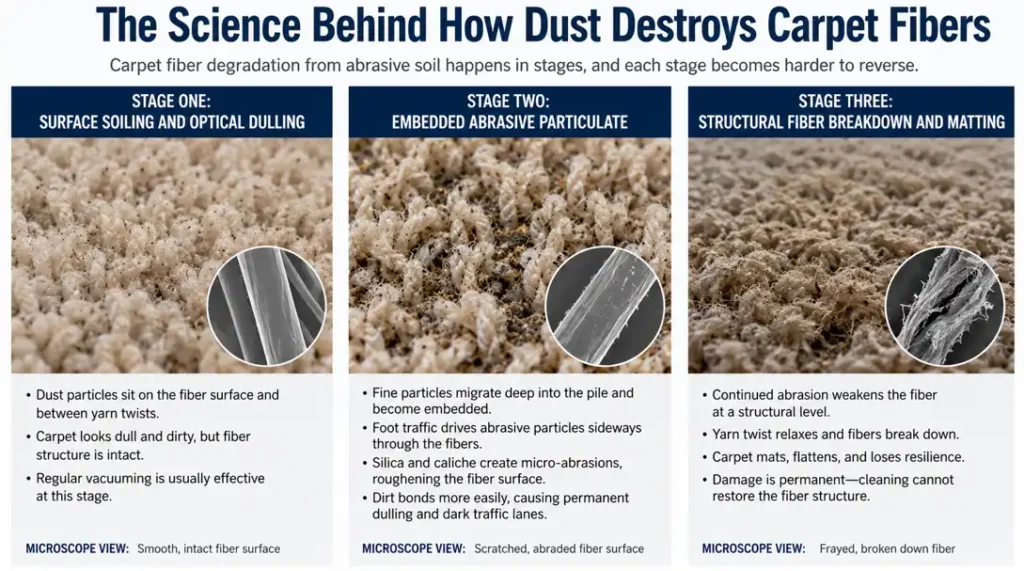
Carpet fiber degradation from abrasive soil happens in stages, and understanding each stage helps explain why the damage becomes progressively harder to reverse.
Stage One: Surface Soiling and Optical Dulling
In the earliest phase, dust particles settle onto the surface of carpet fibers and fill the spaces between yarn twists. This is the stage that regular vacuuming addresses most effectively. The carpet looks dirty, but the fibers themselves are largely unaffected. Color loss at this stage is primarily optical, meaning the dust coating scatters light differently than clean fiber, making the carpet appear duller and more muted than it actually is.
Most homeowners who vacuum consistently address Stage One effectively. The problem in San Angelo is that the volume and fineness of West Texas particulate means this stage is reached much faster than in humid or wetter climates where heavier particles fall out of the air quickly rather than staying suspended and infiltrating carpet fibers.
Stage Two: Embedded Abrasive Particulate
When vacuuming is delayed, infrequent, or conducted with a low-powered machine, the finer particles migrate downward through the carpet pile by a process called particle settling, accelerated by foot traffic. Once particles reach the base of the pile near the primary backing, they become extremely difficult to remove without professional extraction equipment.
At this stage, every step across the carpet drives those particles laterally through the fiber structure. Silica and caliche particles caught between fibers create micro-abrasions along the fiber shaft with each compression and release cycle. Under a microscope, these show up as longitudinal scratches along what should be a smooth fiber surface. Over weeks and months of this process, the fiber surface becomes permanently roughened, losing its ability to reflect light evenly and resist subsequent soiling.
This is the stage where carpet ages visibly and rapidly. Traffic lanes begin to look permanently darker than surrounding areas even after cleaning, because the roughened fiber surface holds onto new soil much more aggressively than intact fiber does.
Stage Three: Structural Fiber Breakdown and Matting
In the final stage of abrasive damage, the weakened fiber strands begin to break down at the structural level. Twisted yarn constructions, which are the dominant construction type in residential carpet, rely on fiber integrity to maintain their twist and resilience. Once fibers are compromised by micro-abrasion, the twist relaxes and the yarn flattens, producing the matted appearance that most homeowners associate with old, worn-out carpet.
This matting is permanent. No amount of professional cleaning or grooming can restore the structural twist to yarn that has been physically broken down by abrasive particulate. At Stage Three, the carpet’s functional lifespan is essentially over in the affected areas.
How West Texas Humidity Conditions Make Dust Damage Worse
The low relative humidity in San Angelo compounds the abrasive damage problem in ways that are not immediately obvious. In humid environments, airborne particles tend to clump together due to moisture and fall out of the air faster. They also carry a slight electrostatic charge reduction from atmospheric moisture, which makes them less likely to cling aggressively to carpet fibers.
In West Texas’s dry conditions, the opposite is true. Fine particles stay airborne longer, travel deeper into homes, and carry stronger electrostatic charges that cause them to bond tightly to carpet fiber surfaces. This is why West Texas dust has a characteristic tendency to cling to walls, furniture, and yes, carpet, in ways that feel almost sticky despite being dry particulate.
Low humidity also affects carpet fiber itself. Most residential carpet fibers, including nylon, which is the highest-performing common fiber, maintain optimal resilience within a relative humidity range of 40 to 60 percent. When indoor humidity drops below that range, which it frequently does in San Angelo during dry spells, the fibers become slightly more brittle and less elastic. This brittleness makes them more susceptible to abrasive damage because the fiber cannot flex and recover from micro-impacts as efficiently.
The combination of more aggressive particulate attachment and reduced fiber resilience creates a compounding effect that accelerates wear significantly compared to what the same carpet would experience in a more moderate climate.
The Role of HVAC Systems in Spreading Dust Through Your Home
One aspect of dust damage that San Angelo homeowners frequently underestimate is the role their heating and cooling systems play in distributing particulate throughout the home. Central HVAC systems cycle air repeatedly through ductwork, and when filters are not changed frequently enough, the system becomes a mechanism for spreading fine dust rather than removing it. This same airborne particulate settles not just on carpets but also on upholstered furniture — another reason why upholstery cleaning is worth scheduling alongside your regular carpet maintenance in a dusty West Texas home.
West Texas homes with standard 1-inch HVAC filters running on a monthly replacement schedule can still allow fine silica and clay particles to pass through and be distributed via supply vents directly onto carpet surfaces in every room of the home. The particles are small enough to pass through lower-MERV-rated filters while still being large enough to cause abrasive fiber damage.
The American Society of Heating, Refrigerating and Air-Conditioning Engineers recommends MERV 13 filtration as the standard for good indoor air quality in residential settings. In a high-particulate environment like San Angelo, this standard is particularly relevant. Upgrading to MERV 13 filters and changing them every three to four weeks during high-dust seasons rather than monthly makes a measurable difference in the volume of particulate reaching carpet surfaces. Commercial properties in San Angelo face even greater challenges from HVAC-distributed dust — a key reason why commercial carpet cleaning on a more frequent schedule is strongly advisable for offices and retail spaces in the area.
It is also worth noting that HVAC ductwork in older San Angelo homes, particularly those built before the 1990s, may have accumulated significant dust deposits in the ducts themselves. A professional duct cleaning every three to five years is a meaningful component of a comprehensive indoor air quality and carpet protection strategy.
How Long Should Carpet Last in San Angelo Compared to Other Climates
Carpet manufacturers typically rate residential carpet lifespan at 10 to 15 years for mid-grade products and 15 to 25 years for premium nylon constructions under normal maintenance conditions. Those ratings assume moderate soil conditions, consistent vacuuming, and professional cleaning every 12 to 18 months as recommended by the Carpet and Rug Institute (CRI).
In San Angelo’s environment, without proactive maintenance, it is not uncommon for carpet in high-traffic areas to show Stage Two and Stage Three abrasive damage within five to eight years of installation. Homeowners who discover this often assume they purchased low-quality carpet, when in reality the environmental conditions simply exceeded what the carpet’s maintenance program was designed to handle.
With proper maintenance specifically designed for West Texas conditions, including more frequent vacuuming, higher-grade HVAC filtration, entry point management, and professional cleaning on an accelerated schedule, carpet lifespan in San Angelo can be extended meaningfully. The goal is not to match the performance of carpet in Seattle or Atlanta but to get as close to the manufacturer’s rated lifespan as the local environment allows.
Extend Your Carpet Life — Book a Cleaning Today
What Types of Carpet Hold Up Best Against West Texas Dust
Not all carpet fiber types respond to abrasive particulate equally, and understanding the differences helps San Angelo homeowners make smarter decisions when replacing carpet or installing new flooring.
Nylon
Nylon is the most resilient of the common residential carpet fibers and holds up better to abrasive soil than any alternative at a comparable price point. Its high tensile strength means it can withstand more micro-abrasion cycles before structural degradation becomes visible. Solution-dyed nylon, where color is incorporated into the fiber during manufacturing rather than applied afterward, also resists the color loss that comes from surface abrasion more effectively than piece-dyed alternatives. For San Angelo homes, nylon is the most defensible choice.
Polyester and PET
Polyester, including the PET (polyethylene terephthalate) variants often made from recycled materials, offers good initial stain resistance but is significantly more susceptible to abrasive matting than nylon. The fiber has less elastic memory, meaning once the twist is disturbed by embedded particulate and foot traffic, it recovers poorly. In a high-dust environment, polyester carpet in traffic lanes can look worn within three to five years. It is best suited for low-traffic rooms in San Angelo homes.
Triexta (PTT)
Triexta, marketed under brand names including Mohawk’s SmartStrand, occupies a position between nylon and polyester in terms of durability. Its inherent stain resistance is excellent, but its abrasion resistance under heavy particulate load is somewhat less than premium nylon. It performs well in San Angelo homes with consistent maintenance but may not hold up as long as nylon in the highest-traffic areas of a working household.
Wool
Natural wool carpet offers exceptional resilience and has a scale-like fiber structure that releases soil more readily than synthetic fibers. However, wool’s higher cost and greater sensitivity to pH extremes in cleaning products require careful handling. In San Angelo’s dry environment, wool also needs careful humidity management to prevent brittleness. It is an excellent performer for the right household and budget, but it requires a more attentive maintenance program.
Olefin (Polypropylene)
Olefin is the least suitable fiber choice for high-traffic areas in a West Texas environment. It is highly resistant to moisture and outdoor conditions, which makes it popular for basements and outdoor-rated applications, but it has very low abrasion resistance and mats rapidly under abrasive soil conditions. Avoid olefin in any San Angelo room that receives regular foot traffic.
Entry Points: Where Dust Damage Actually Begins
A significant proportion of the abrasive particulate that damages carpet in San Angelo homes enters through a small number of predictable pathways. Addressing those entry points is one of the most cost-effective investments a homeowner can make.
The primary entry point is foot traffic through exterior doors. Research from Lawrence Berkeley National Laboratory has documented that footwear tracked in from outdoors accounts for a substantial majority of indoor floor soil. In West Texas, where exterior surfaces including driveways, lawns, and sidewalks accumulate fine mineral dust constantly, the amount tracked in per person per entry is particularly high.
A two-mat system at each exterior entry point, combining a coarse-bristle exterior mat to remove heavy debris and a high-quality absorbent interior mat to capture fine particles, can reduce tracked-in soil by a significant margin. Combined with a consistent shoe-removal habit, this single intervention may do more for carpet longevity in a San Angelo home than any other individual measure.
Secondary entry points include pet doors, which allow continuous air movement and attached particulate to enter the home, garage entry doors, which bring in particulate from the typically dusty garage environment, and poorly sealed window and door frames, which allow fine particles to infiltrate during windy conditions. Weatherstripping and door sweep maintenance is worth inspecting annually.
The Right Vacuuming Strategy for West Texas Conditions
Standard vacuuming recommendations are based on typical suburban environments and do not fully account for the particulate load that San Angelo homes accumulate. Adapting the vacuuming program to local conditions is straightforward once you understand what you are trying to accomplish.
Frequency Matters More Than Technique
In most carpet care guides, vacuuming twice per week in high-traffic areas is the standard recommendation. In San Angelo, particularly during spring dust season and following any windstorm event, those areas benefit from daily vacuuming. The goal is to remove surface and near-surface particulate before it migrates downward into the pile where abrasive damage begins.
HEPA Filtration Is Not Optional Here
A vacuum cleaner equipped with HEPA (High Efficiency Particulate Air) filtration captures particles down to 0.3 microns at 99.97 percent efficiency. This matters in West Texas because fine silica particles are small enough to pass through standard vacuum filters and be re-deposited onto carpet surfaces during vacuuming. An unsealed or non-HEPA vacuum essentially redistributes fine particulate rather than removing it. Brands including Miele, Dyson, and Shark offer HEPA-sealed models across a range of price points.
Slow, Overlapping Passes Remove More Particulate
The speed at which a vacuum is pushed across the carpet surface directly affects how much soil is captured. Slow passes allow the beater brush and suction to work together more effectively on embedded particulate. Using overlapping passes in multiple directions on heavily soiled areas further improves removal of stubborn embedded particles.
Professional Cleaning Schedules for San Angelo Homes
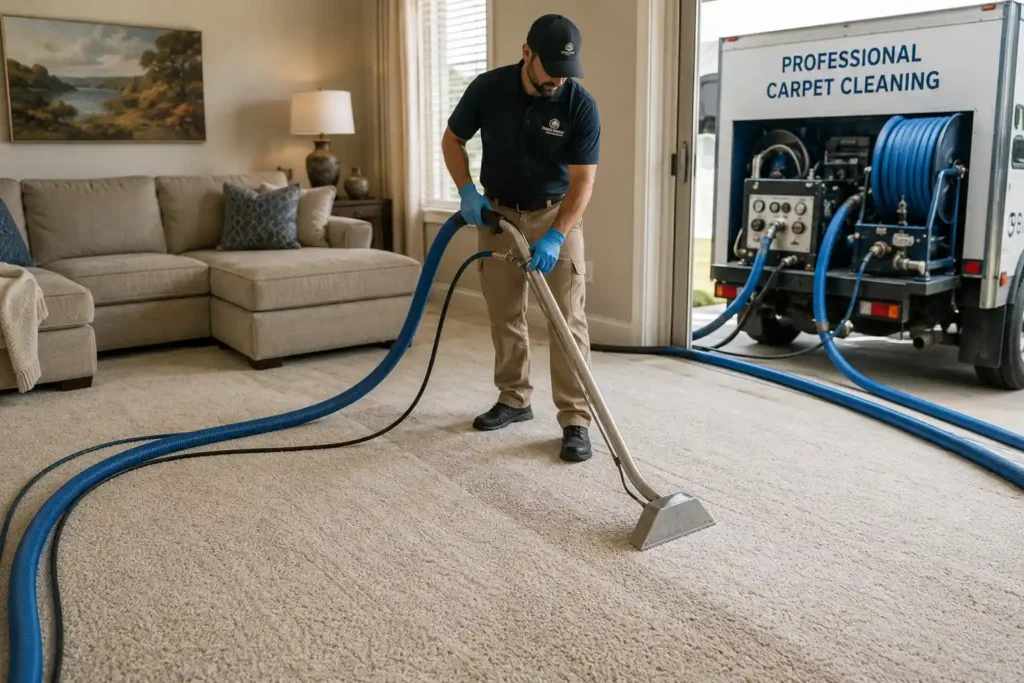
The Carpet and Rug Institute recommends professional hot water extraction cleaning every 12 to 18 months under standard conditions. For San Angelo homes, particularly those in areas of Tom Green County that experience significant wind-driven dust exposure, adjusting that schedule is advisable.
Homes with two or more occupants, regular foot traffic, and no shoe-removal policy benefit from professional cleaning every 9 to 12 months. Homes with pets add another layer of organic material that interacts with mineral dust to create a compacted, adhesive soil layer at the base of the pile, making a cleaning schedule closer to every 6 to 9 months appropriate.
When selecting a carpet cleaning company for a West Texas home, look specifically for providers that use truck-mounted hot water extraction equipment. The higher water temperature and extraction power of truck-mounted systems are particularly important for removing the fine, dry mineral particulate that characterizes San Angelo’s soil environment. Portable extraction machines simply do not generate adequate suction to remove deeply embedded caliche and silica particles effectively.
Enzyme-based pre-treatments applied before hot water extraction can help break the bond between mineral particulate and fiber surfaces, improving removal efficiency. Ask your cleaning provider whether they use pre-treatment as a standard step or only as an add-on service.
Schedule Your Deep Carpet Cleaning in San Angelo
Carpet Protectant and Its Role in a Dusty Environment
Fluorochemical carpet protectants, including products marketed under the Scotchgard brand by 3M and similar formulations, create a protective coating around individual carpet fibers that reduces the rate at which soil bonds to the fiber surface. This coating does not prevent dust from entering the carpet but does make it easier to remove through vacuuming before it migrates to the damaging lower pile zone.
In San Angelo’s environment, applying a quality carpet protectant after each professional cleaning is particularly worthwhile. The protectant wears off gradually through foot traffic and cleaning, which is why reapplication after each professional extraction is the standard recommendation. A protectant applied to clean fiber and refreshed regularly can meaningfully slow the progression from Stage One to Stage Two abrasive damage by keeping fine particles more accessible to vacuum suction.
It is important to note that not all protectants are equal. Look for providers that apply protectants specifically formulated for the carpet fiber type in your home, as nylon and polyester respond somewhat differently to various protectant chemistries.
Signs Your Carpet Has Already Suffered West Texas Dust Damage
Understanding the warning signs of abrasive dust damage helps homeowners act before damage becomes irreversible.
Permanent traffic lane darkening that does not fully lift after professional cleaning is a primary indicator that Stage Two damage has progressed significantly. The roughened fiber surface in those lanes holds onto new soil far more aggressively than surrounding intact fiber, creating a contrast that cleaning cannot eliminate.
Visible matting and flattening in traffic areas where the carpet pile no longer stands upright after cleaning or grooming indicates Stage Three structural breakdown. The yarn twist has been permanently compromised and cannot be restored.
A gritty texture underfoot, particularly noticeable when walking barefoot, indicates heavy particulate loading in the lower pile. This grit is actively abrading fibers with every step and should prompt immediate professional attention.
Increased allergy symptoms in household members, particularly respiratory irritation and sneezing, can be a sign that carpet is releasing accumulated particulate into the breathing zone rather than holding it until the next vacuum session. When carpet fiber is damaged and the pile structure is compromised, the carpet’s natural filtering function breaks down and previously captured particles become airborne again.
Protecting Your Carpet Investment in San Angelo: A Practical Summary
San Angelo’s West Texas environment creates a uniquely demanding set of conditions for residential carpet. The combination of abrasive mineral dust, low humidity, dry seasonal winds across the Concho Valley, and the high-traffic nature of family living makes a proactive, locally adapted maintenance program essential for anyone who wants to get full value from their carpet investment.
The most impactful steps are consistent and achievable. Vacuuming more frequently with a HEPA-equipped machine, upgrading HVAC filtration to MERV 13, managing entry points with quality matting and shoe removal, scheduling professional hot water extraction cleaning on an accelerated timeline, and applying carpet protectant after each professional cleaning collectively address all three stages of abrasive dust damage before they become permanent.
Carpet is not an inexpensive investment. In a typical San Angelo home, floor covering represents thousands of dollars that homeowners rightfully expect to last. Understanding the specific environmental forces working against that investment is the first step toward making decisions that extend it significantly.