
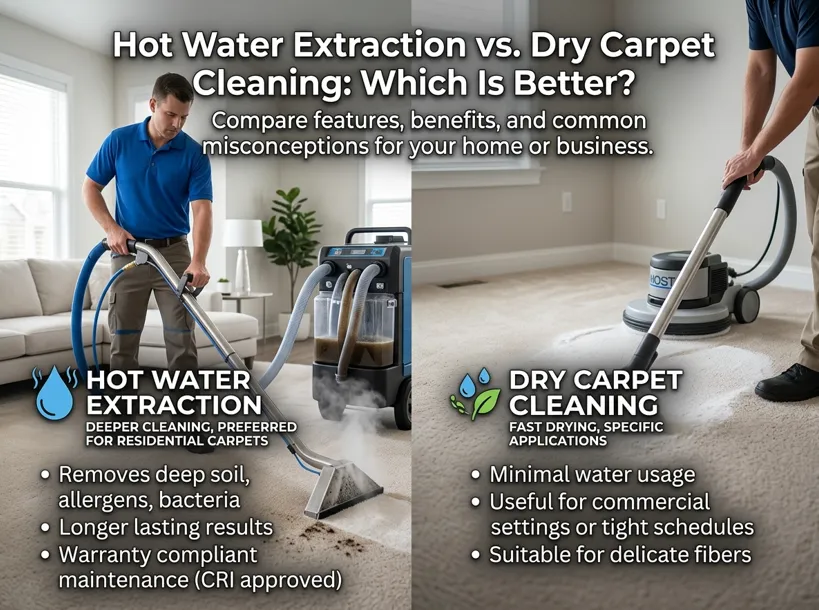
Hot Water Extraction vs. Dry Carpet Cleaning: Which Is Better?
Hot water extraction is better than dry carpet cleaning for most residential situations because it removes significantly more embedded soil, allergens, bacteria, and biological contamination from deep within carpet fibers, producing cleaner results that last longer and meet the standards set by the Carpet and Rug Institute (CRI) and most carpet manufacturers for warranty-compliant maintenance. Dry carpet cleaning methods, while genuinely useful in specific circumstances including commercial settings with zero-downtime requirements or for delicate fiber types sensitive to moisture, cannot match the depth of cleaning that hot water extraction achieves in a typical home environment. That said, choosing between the two methods correctly requires understanding what each actually does, where each genuinely excels, and where the marketing around both methods overstates or misrepresents reality.
This is a question where the carpet cleaning industry has not always served consumers well. Dry cleaning companies market their method as superior by emphasizing the elimination of drying time and the risks of over-wetting. Hot water extraction companies counter by emphasizing cleaning depth and allergen removal. Both arguments contain truth, and both omit important context. This guide gives you the complete picture without a commercial stake in either answer.
What Hot Water Extraction Actually Is and How It Works
The term steam cleaning is used interchangeably with hot water extraction in most consumer contexts, but it is worth understanding that true steam, meaning vaporized water above 212 degrees Fahrenheit, is not what residential carpet cleaning machines deliver. What hot water extraction actually delivers is heated water, typically between 150 and 200 degrees Fahrenheit, combined with a cleaning solution, injected into carpet pile under pressure and then immediately extracted by powerful suction.
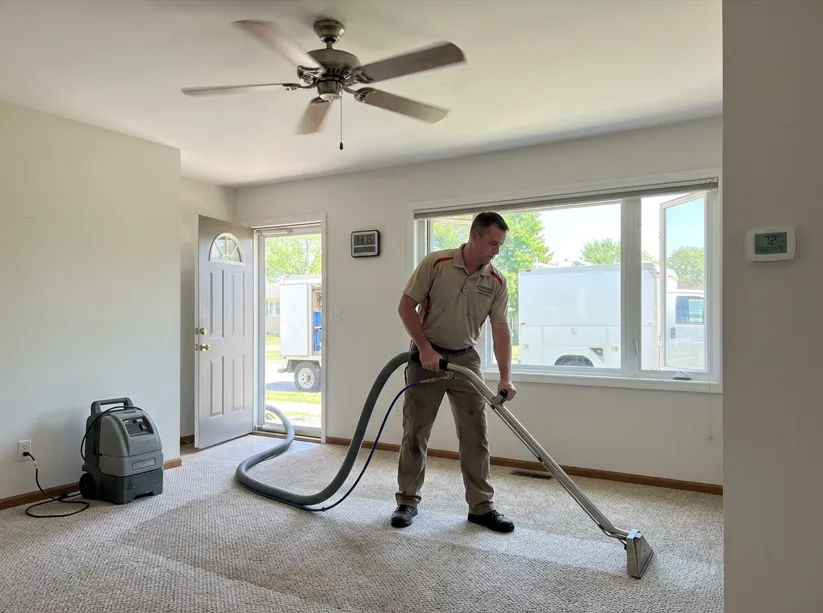
The process works in three stages. In the first stage, a pre-conditioner or cleaning solution is applied to the carpet and allowed to dwell for several minutes. This solution begins breaking down the chemical bonds between soil particles and carpet fibers, making the subsequent extraction more effective. In the second stage, the hot water injection wand delivers pressurized heated water into the carpet pile, flushing loosened soil into suspension. In the third stage, the extraction mechanism, which in truck-mounted systems generates suction equivalent to several times the power of the strongest consumer vacuum, pulls the water along with suspended soil, allergens, and biological material out of the carpet and into the waste tank.
The temperature component serves several important functions beyond simply helping to dissolve soil. Heat denatures biological allergens including dust mite proteins, which are a primary trigger for allergic rhinitis and asthma. Heat also reduces the surface tension of water, improving its penetration into carpet fiber bundles. And heat accelerates the evaporation that occurs during the drying phase, particularly when combined with air movement.
Truck-mounted hot water extraction systems, operated from a van or truck parked outside the home with hoses running inside, generate substantially higher temperatures and suction power than portable extraction units that technicians carry into the home. The distinction matters practically because portable units, while adequate for light maintenance cleaning, cannot achieve the extraction efficiency of truck-mounted systems on heavily soiled carpet. When evaluating carpet cleaning services in San Angelo, asking specifically whether they use truck-mounted or portable equipment is one of the most consequential questions you can ask.
What Dry Carpet Cleaning Actually Is and How It Works
Dry carpet cleaning is an umbrella term covering several distinct methods that share the characteristic of using little or no water. The three most common dry methods in residential and commercial use are dry compound cleaning, encapsulation cleaning, and dry foam cleaning.
Dry Compound Cleaning
Dry compound cleaning uses a biodegradable absorbent powder, often based on materials including corn cob, sawdust, or cellulose, that is treated with cleaning agents and solvents. The compound is worked into carpet pile using a counter-rotating brush machine, where it absorbs soil from the fiber surface. After a dwell period of typically 10 to 15 minutes, the compound along with the soil it has absorbed is vacuumed away. This method produces virtually no drying time and can be used on most fiber types without risk of over-wetting.
The limitation is depth of cleaning. Dry compound remains in the upper portion of carpet pile and does not penetrate to the base of the fiber bundle where the most damaging abrasive particulate accumulates. It cleans the top portion of what is visible and accessible, which improves appearance effectively but does not address the deeper contamination that drives fiber degradation and allergen accumulation.
Encapsulation Cleaning
Encapsulation applies a polymer solution to carpet that surrounds soil particles and, as it dries, crystallizes into a brittle residue. The crystallized encapsulant along with the soil it has surrounded is then removed by vacuuming. This method is particularly popular for commercial carpet cleaning maintenance because it dries quickly, does not require heavy equipment, and can be performed without taking a space out of service.
Encapsulation is best understood as a maintenance method rather than a deep cleaning method. It is highly effective at keeping lightly soiled commercial carpet presentable between periodic deep cleanings with hot water extraction, but it is not appropriate as the primary cleaning method for heavily soiled residential carpet.
Dry Foam Cleaning
Dry foam cleaning applies a whipped foam cleaning solution to carpet, works it into the pile with a rotary or cylindrical brush, and then extracts the foam along with suspended soil. Despite the dry designation, dry foam does introduce some moisture into the carpet, though significantly less than hot water extraction. Results fall between encapsulation and hot water extraction in terms of cleaning depth.
Side-by-Side Comparison: Hot Water Extraction vs. Dry Carpet Cleaning
| Feature | Hot Water Extraction | Dry Carpet Cleaning |
|---|---|---|
| Cleaning Depth | Deep pile and backing | Surface to mid-pile only |
| Allergen Removal | High: removes dust mites, dander, mold spores | Moderate: surface allergens only |
| Drying Time | 4 to 8 hours (truck-mount) | 0 to 1 hour |
| Equipment Type | Truck-mounted or portable unit | Rotary machine, portable applicator |
| Best For | Residential deep cleaning, allergy households | Commercial maintenance, delicate fibers |
| Recommended By | CRI, most carpet manufacturers | Commercial facility managers |
| Soil Removal Rate | Up to 94 percent (CRI-tested) | 60 to 75 percent (surface soil) |
| Mold and Bacteria | Effectively addresses with heat | Does not address biological growth |
| Fiber Safety | Safe when done correctly | Safe for most fiber types |
| VOC Removal | Partial removal via flushing | Minimal |
| Cost Range | $150 to $400 residential | $100 to $250 residential |
| Warranty Compliance | Required by most manufacturers | Not accepted by most manufacturers |
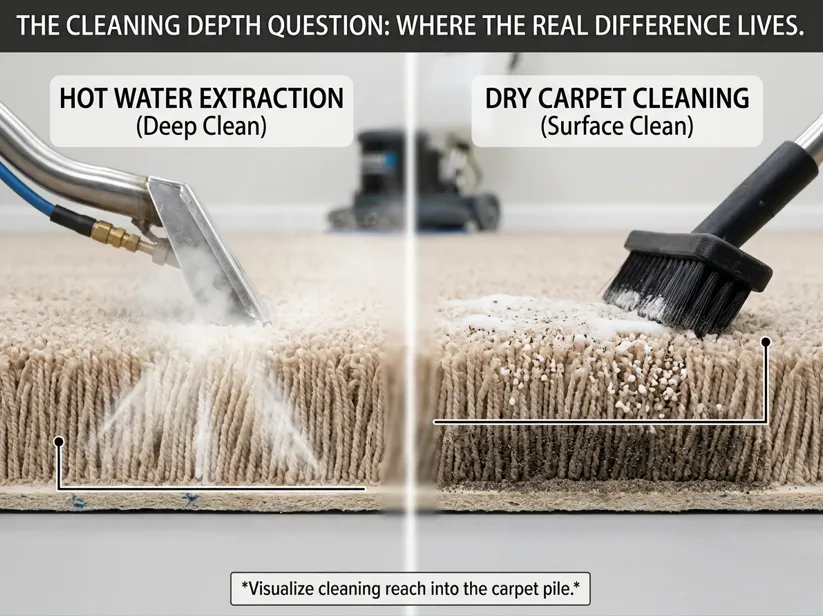
The Cleaning Depth Question: Where the Real Difference Lives
The most meaningful difference between hot water extraction and dry carpet cleaning is not drying time, cost, or convenience. It is cleaning depth, and understanding why cleaning depth matters helps frame every other comparison between the two methods.
Carpet pile is not a uniform structure. It consists of fiber bundles twisted or looped into yarn, attached to a primary backing, and in most residential installations, sitting above a secondary backing and a separate pad. The portion of carpet that dry cleaning methods address effectively is the upper half to two thirds of the pile height, meaning the section of each fiber bundle that is visible and accessible from the surface. The lower portion of each fiber bundle, the area closest to the primary backing, is where the most damaging abrasive particulate accumulates because gravity pulls fine particles downward through the pile over time. This deep particulate buildup is a particularly serious problem for homeowners in Ballinger, Christoval, and Miles, where West Texas caliche and silica dust infiltrates carpet fibers far faster than in most other climates.
Hot water extraction reaches this lower zone effectively because the combination of pressurized water injection and powerful suction creates a hydraulic flushing action through the full depth of the pile. Dry cleaning methods, which work primarily through mechanical agitation and absorption at the surface, cannot produce this flushing effect. The particles that cause the most carpet fiber damage over time, the fine mineral grit and silica that cuts into fiber surfaces with every footstep, are in the zone that dry cleaning consistently under-addresses.
This is not a theoretical distinction. The IICRC S100 Standard and Reference Guide for Professional Carpet Cleaning addresses cleaning method selection based on soil type and depth of contamination, and consistently identifies hot water extraction as the appropriate method for deep cleaning of residential carpet with embedded soil.
Allergen Removal: A Category Where Method Choice Has Health Consequences
For the approximately 50 million Americans who experience some form of allergic disease, according to the American College of Allergy, Asthma and Immunology (ACAAI), the allergen removal performance of a carpet cleaning method is not a minor consideration. It is a health decision with measurable consequences.
Dust mite allergens are the most clinically significant carpet-derived allergens in residential settings. The primary dust mite allergen proteins, designated Der p 1 from Dermatophagoides pteronyssinus and Der f 1 from Dermatophagoides farinae, are held in fecal particles and body fragments that accumulate throughout carpet pile. They are electrostatically attracted to fiber surfaces and resist removal by dry mechanical methods.
Hot water extraction denatures these proteins through heat exposure and physically removes them through the hydraulic flushing and suction process. Research published in the Journal of Allergy and Clinical Immunology and studies commissioned by the CRI have documented significant reductions in measurable dust mite allergen levels following hot water extraction, with improvements that persist for weeks to months after the cleaning. Dry cleaning methods reduce surface-level allergen concentrations without addressing the allergen reservoir in the lower pile, producing shorter-term symptom relief that does not persist as long after cleaning.
For households with asthma sufferers, children with documented dust mite allergy, or pets whose dander has accumulated in carpet over time, this difference in allergen removal performance is a compelling reason to choose professional hot water extraction cleaning regardless of the convenience advantages of dry methods.
Book a Truck-Mounted Hot Water Extraction — Free Quote
Where Dry Cleaning Genuinely Has the Advantage
A fair analysis requires acknowledging the situations where dry carpet cleaning methods are the better choice, not as a marketing concession but as a genuine reflection of where the method’s characteristics produce superior outcomes.
Zero Downtime Commercial Environments
Hospitals, hotels, retail spaces, and office buildings often cannot afford the four to eight hour drying time that hot water extraction requires. A hotel room that cannot be rented while carpet dries, or a retail floor section closed during peak hours, represents a tangible business cost. In these environments, encapsulation or dry compound cleaning performed frequently as a maintenance method, combined with periodic hot water extraction during scheduled closures, is a legitimate and professionally supported strategy.
Certain Natural Fiber Carpets
Wool, sisal, jute, and sea grass carpets can react poorly to the moisture levels introduced by hot water extraction if not handled by a technician specifically trained and experienced with natural fiber cleaning. These fibers can shrink, felt, or develop browning when over-wet or when the pH of the cleaning solution is not carefully controlled. For natural fiber area rugs and carpets, dry cleaning methods or very low-moisture hot water extraction performed by specialists with natural fiber experience are often the safer approach.
Maintenance Between Deep Cleaning Sessions
Encapsulation cleaning is legitimately useful as a bridge maintenance method between hot water extraction sessions in both residential and commercial settings. Applied to carpet that is not heavily soiled, it extends the interval before the next hot water extraction session is needed by keeping surface soil from migrating downward and extending the period during which the carpet remains visually acceptable. Using both methods strategically is a more sophisticated approach than treating the choice as a binary one.
Situations Where Drying Risk Is Genuinely Elevated
In very humid climates or poorly ventilated spaces where carpet drying after hot water extraction would take significantly longer than the standard four to eight hours, the mold risk from extended moisture exposure in carpet and pad becomes a legitimate concern. In these specific circumstances, a very low-moisture cleaning approach may be more appropriate than standard hot water extraction. An experienced IICRC-certified technician can assess this risk and adjust accordingly.
The Drying Time Argument: How Much Does It Actually Matter
The drying time advantage of dry carpet cleaning is the most prominently featured marketing argument for those methods, and it deserves an honest evaluation because it resonates with real homeowner concerns.
Hot water extraction performed with truck-mounted equipment by an experienced technician on a well-maintained carpet in a ventilated space typically produces drying times of four to six hours. This is not the twelve to twenty-four hours that anti-extraction marketing sometimes implies, and the difference between truck-mounted and portable equipment is significant here. Truck-mounted systems extract far more moisture from carpet during the cleaning process than portable units, leaving the carpet considerably drier at the end of the session.
Several factors within the homeowner’s control reduce drying time further. Running ceiling fans at high speed during and after cleaning accelerates evaporation meaningfully. Opening windows when outdoor humidity is lower than indoor humidity creates airflow that removes moisture-laden air. Maintaining moderate indoor temperature rather than cooling the space significantly with air conditioning during the drying period also helps, since cooler air holds less moisture and slows evaporation.
The honest assessment is that for most households, a four to six hour drying window is manageable with modest scheduling adjustment. Planning a carpet cleaning appointment in San Angelo for a morning when occupants will be away during the afternoon addresses the drying time concern without requiring any compromise on cleaning quality. The drying time is a real factor but rarely the insurmountable obstacle that dry cleaning marketing presents it as.
What Carpet Manufacturers Actually Require
One of the most practically significant and least discussed aspects of the hot water extraction versus dry cleaning debate is its implications for carpet warranty compliance. Most residential carpet manufacturers specify the cleaning methods that maintain warranty validity, and the overwhelming consensus in those specifications favors hot water extraction.
Shaw Industries, Mohawk Flooring, Stainmaster, and Karastan, among the largest residential carpet manufacturers in North America, specify hot water extraction, or in some documentation the equivalent term steam cleaning, as the required professional cleaning method for maintaining their carpet warranties. Dry cleaning methods, including dry compound and encapsulation, are generally not accepted as warranty-compliant cleaning methods by these manufacturers.
This matters practically in situations where a carpet develops premature wear, permanent staining, or structural failure within the warranty period and a claim is filed. If the cleaning history of the carpet cannot demonstrate hot water extraction at appropriate intervals, the manufacturer has grounds to deny the claim on maintenance grounds. Homeowners investing in premium carpet with meaningful warranty coverage protect that investment by using professional carpet cleaning with hot water extraction as their primary maintenance method regardless of other considerations.
Over-Wetting: The Risk That Dry Cleaning Companies Correctly Identify
The most legitimate criticism that advocates of dry cleaning methods level against hot water extraction is the risk of over-wetting, and it deserves a direct and honest response because it is a real risk when the work is not done correctly.
Over-wetting occurs when hot water extraction introduces more moisture into carpet and pad than the extraction mechanism removes, leaving the carpet significantly wet rather than damp after the cleaning session. When this moisture reaches the carpet backing and pad, and particularly when it remains there for more than 24 to 48 hours without drying, conditions for mold and mildew growth develop. According to the EPA’s indoor air quality guidelines, mold in carpet backing and pad produces persistent air quality problems that are expensive and difficult to resolve.
Over-wetting is almost exclusively a consequence of poor technique or inadequate equipment rather than an inherent characteristic of hot water extraction as a method. Experienced IICRC-certified technicians using properly maintained truck-mounted equipment make multiple slow extraction passes to remove the maximum possible moisture from the carpet before concluding the session. The result is carpet that is damp to the touch but not wet, and that dries to its normal condition within a few hours under normal ventilation.
Choosing an IICRC-certified provider who uses truck-mounted equipment and can demonstrate experience with your carpet fiber type essentially eliminates the over-wetting risk in practice. The risk is real when work is done by undertrained technicians with inadequate equipment, which is why certification and equipment verification matter in provider selection.
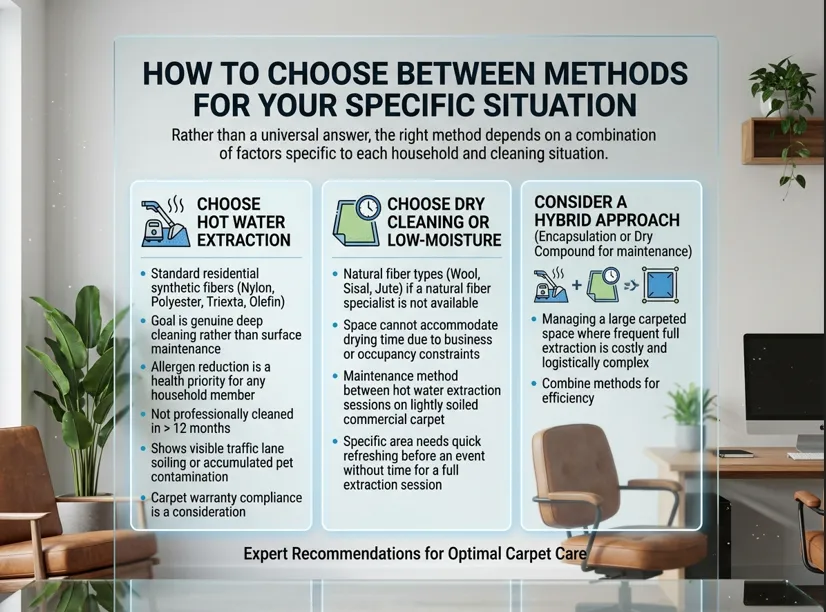
How to Choose Between Methods for Your Specific Situation
Rather than a universal answer, the right method depends on a combination of factors specific to each household and cleaning situation.
Choose hot water extraction when your carpet is a standard residential synthetic fiber type including nylon, polyester, triexta, or olefin. Choose it when the cleaning goal is genuine deep cleaning rather than surface maintenance. Choose it when allergen reduction is a health priority for any household member. Choose it when the carpet has not been professionally cleaned in more than 12 months. Choose it when the carpet shows visible traffic lane soiling or has accumulated pet contamination. Choose it when carpet warranty compliance is a consideration.
Choose dry cleaning or low-moisture methods when the carpet is a natural fiber type including wool, sisal, or jute and a specialist in natural fiber cleaning is not available. Choose it when the space genuinely cannot accommodate drying time due to business or occupancy constraints. Choose it as a maintenance method between hot water extraction sessions on lightly soiled commercial carpet. Choose it when a specific area needs quick refreshing before an event without time for a full extraction session.
Consider a hybrid approach, meaning encapsulation or dry compound for maintenance sessions between periodic hot water extraction deep cleaning sessions, when managing a large carpeted space where the cost and logistical complexity of frequent full extraction cleaning is impractical. If you also have upholstered furniture in your home, pairing your carpet extraction session with upholstery cleaning in the same visit is the most efficient way to reduce overall allergen load in a single appointment.
Schedule Your Carpet Cleaning in San Angelo Today
Finding a Qualified Provider for Either Method
Regardless of which method is appropriate for a given situation, the quality of the technician and equipment performing the work matters as much as the method itself. An IICRC-certified technician using excellent technique and appropriate equipment will produce better results with either method than an uncertified technician using inferior equipment with poor technique.
For hot water extraction, the IICRC CCT (Carpet Cleaning Technician) certification and IICRC Firm Certification are the primary credentials to verify. Ask specifically about truck-mounted versus portable equipment. Ask about the pre-treatment process, the cleaning solutions used, and the expected drying time. A provider who can answer these questions clearly and specifically is demonstrating the professional knowledge that quality work requires.
For dry cleaning, the relevant IICRC certification is the same CCT credential, as it covers multiple cleaning methods. Ask specifically which dry method the company uses, what products are involved, and what results you should expect on your specific carpet type and soil level.
For both methods, verified local reviews, liability insurance, and a satisfaction guarantee that includes returning to address any concerns after the cleaning are the baseline expectations for professional service.
Final Thoughts on Hot Water Extraction vs. Dry Carpet Cleaning
The choice between hot water extraction and dry carpet cleaning is not a close one for most residential carpet situations. Hot water extraction wins on cleaning depth, allergen removal, biological contamination treatment, and manufacturer warranty compliance by margins that are difficult to argue around honestly.
Dry cleaning methods occupy a legitimate and useful position in the carpet care ecosystem, primarily in commercial maintenance applications and specific natural fiber situations, but they are not appropriate substitutes for periodic deep hot water extraction in a family home.
The nuanced answer that most homeowners benefit from is not which method to choose permanently but how to use both strategically: hot water extraction for periodic deep cleaning at intervals appropriate to household conditions, and low-moisture maintenance methods as optional supplements between deep cleaning sessions when they add genuine value. That combined approach, guided by an understanding of what each method actually does, produces the best long-term carpet outcomes available.