
How Dirty Carpet Affects Indoor Air Quality in Your Home
Dirty carpet significantly degrades indoor air quality by trapping and then releasing pollutants including dust mites, pet dander, mold spores, volatile organic compounds, bacteria, and fine particulate matter into the breathing zone of your home. When carpet fibers become saturated with these contaminants beyond what routine vacuuming can manage, everyday activities like walking across the floor, sitting on the carpet, or even running a ceiling fan create enough disturbance to launch previously trapped particles back into the air where they are inhaled by everyone in the household. The EPA has identified indoor air pollution as one of the top five environmental health risks facing Americans, and dirty carpet is one of its most underestimated contributors.
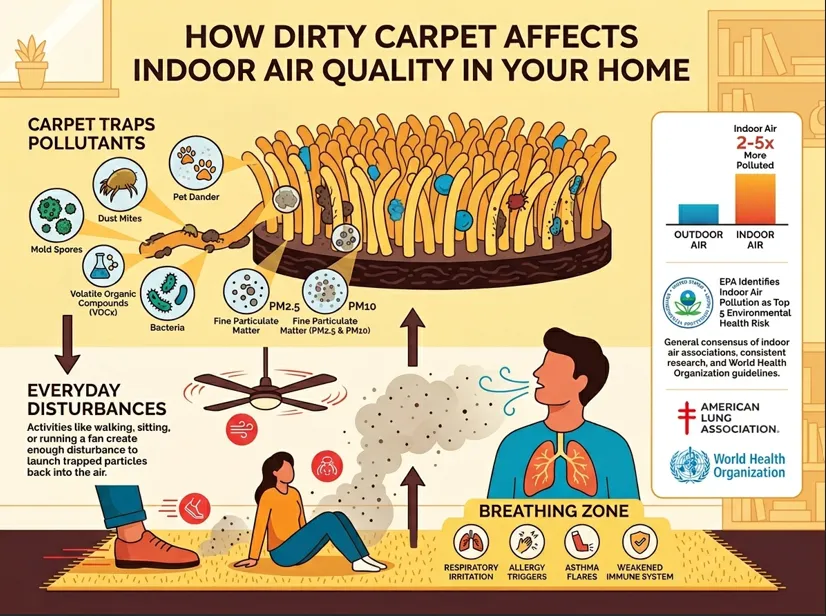
This is not a fringe concern or an exaggeration by the cleaning industry. Research from institutions including the EPA, the American Lung Association, and the World Health Organization consistently identifies indoor air as two to five times more polluted than outdoor air in most homes, and carpet condition is a meaningful variable in that equation. Understanding exactly how dirty carpet affects the air you breathe is the first step toward doing something meaningful about it.
Why Carpet Acts as Both a Filter and a Pollution Source
One of the most important things to understand about carpet is that it plays a dual role in your home’s air quality story, and which role it plays depends almost entirely on how well it is maintained.
Clean, well-maintained carpet functions as a passive air filter. The dense fiber structure traps airborne particles including dust, pollen, pet dander, and mold spores, pulling them out of the breathing zone and holding them in the pile until a vacuum removes them. In this state, carpet actually improves air quality in the immediate breathing zone by keeping particles on the floor rather than suspended at nose and mouth level. This is why research from institutions including the Royal Institute of Technology in Stockholm has found that in some conditions, rooms with carpet have lower levels of airborne particulate than comparable rooms with hard flooring, where particles settle but are easily disturbed back into the air with minimal agitation.
The problem begins when carpet reaches its saturation point, which happens when the volume of trapped pollutants exceeds what the fiber structure can hold and what routine vacuuming can remove. At this point, the carpet transitions from filter to source. Rather than capturing additional particles, it begins releasing previously trapped ones back into the air with every footstep, every furniture movement, and every air current that passes across its surface. This saturation point arrives far sooner than most homeowners expect, particularly in homes with pets, children, or high foot traffic. This is precisely why professional carpet cleaning in San Angelo is not just about appearances — it is a direct investment in the health of your indoor air.
The transition from filter to pollution source is gradual and invisible, which is precisely why so many households live with carpets operating well past their saturation point without realizing the air quality consequences.
The Major Pollutants Trapped in Dirty Carpet
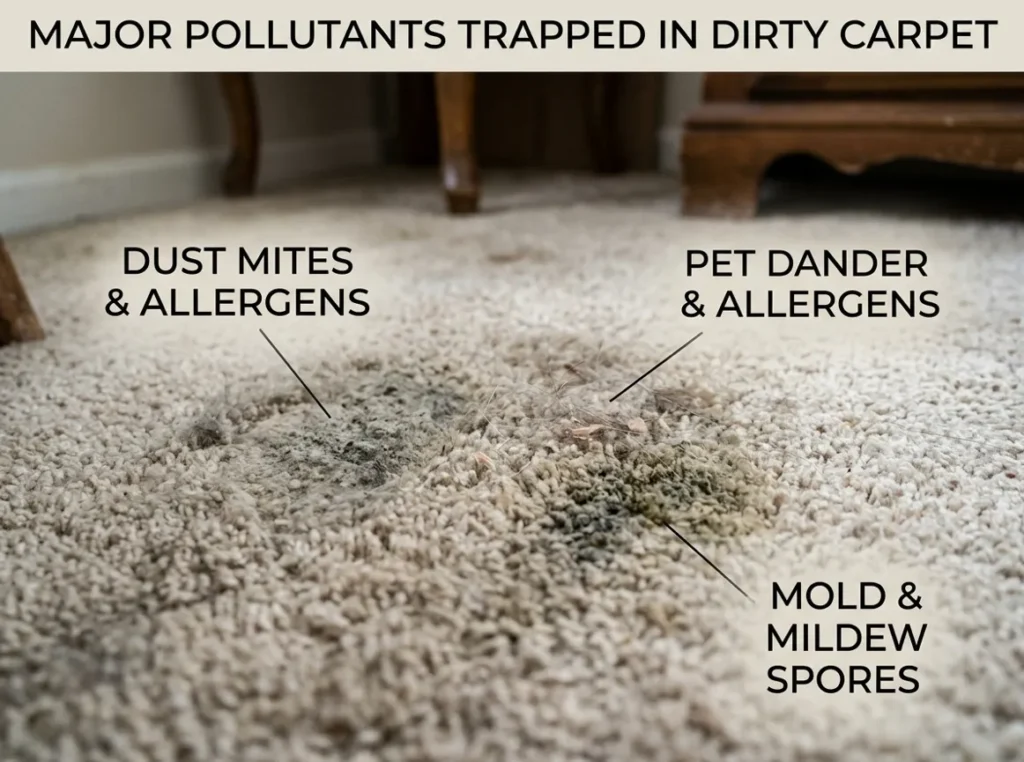
Not all carpet contamination is equal in terms of health impact. Understanding what specifically accumulates in carpet fibers helps prioritize the cleaning strategies that matter most.
Dust Mites and Their Allergens
Dust mites are microscopic arachnids that feed on shed human skin cells, which accumulate in carpet at a significant rate. A single human being sheds approximately 1.5 grams of skin cells per day, enough to feed roughly one million dust mites. The mites themselves are not the primary health concern; their fecal particles and body fragments are. These particles, which measure between 10 and 40 microns in diameter, are small enough to become airborne easily and are a leading trigger for allergic rhinitis and asthma symptoms.
The American Academy of Allergy, Asthma and Immunology (AAAAI) identifies dust mite allergens as among the most common triggers for year-round allergic disease. Carpet provides the ideal habitat for dust mite colonies: warmth, moisture from humidity and foot traffic, and an abundant food supply in the form of skin cell accumulation. A heavily soiled carpet in a moderately humid home can support dust mite populations in the tens of thousands per square meter.
Pet Dander and Allergens
Pet dander, which consists of microscopic flecks of shed skin from dogs, cats, and other animals, is one of the most persistent carpet contaminants because of its physical properties. Dander particles are extremely lightweight and irregular in shape, with microscopic barbs that cause them to cling aggressively to carpet fibers and resist removal by standard vacuuming. They can remain airborne for extended periods once disturbed and can cause allergic reactions at very low concentrations.
The Asthma and Allergy Foundation of America reports that approximately 30 percent of people with allergies have allergic reactions to cats and dogs, and pet dander accumulation in carpet is a primary exposure pathway. Even homes that no longer have pets can have measurable dander concentrations in carpet for months or years after the animal has left. If your household includes pets, professional pet dander removal through hot water extraction is the most effective way to reduce allergen load in your carpet.
Mold and Mildew Spores
Carpet that has experienced moisture intrusion, whether from a spill inadequately dried, high indoor humidity, or water damage, creates conditions that support mold and mildew growth within the carpet pile and, more critically, within the carpet pad beneath. Mold growth in carpet is particularly dangerous from an air quality perspective because the carpet surface continues to look relatively normal even when significant mold colonies have established themselves in the backing and pad where they are invisible to casual inspection.
Mold spores released from carpet are biological particles that trigger respiratory inflammation, allergic reactions, and in cases of prolonged exposure to certain species including Stachybotrys chartarum, more serious health consequences. The CDC and the EPA both recommend professional remediation rather than DIY treatment when mold is suspected in carpet or carpet padding.
Volatile Organic Compounds
Volatile organic compounds, commonly referred to as VOCs, are gases emitted from a wide range of household products and materials. Carpet itself can be a source of VOC off-gassing, particularly new carpet that contains adhesives, backing materials, and fiber treatments that release compounds including formaldehyde, benzene, and styrene during the initial months after installation. This is the source of the characteristic new carpet smell that many people recognize.
Beyond off-gassing from the carpet itself, dirty carpet absorbs and holds VOCs from other household sources including cleaning products, air fresheners, paint, and cooking fumes. When temperature or air movement disturbs these trapped compounds, they are re-released into the indoor air.
Pesticides, Heavy Metals, and Tracked-In Contaminants
Research from Lawrence Berkeley National Laboratory and other environmental research institutions has documented that footwear tracks a remarkable variety of outdoor contaminants into homes, where they accumulate in carpet at concentrations that can significantly exceed outdoor levels. Pesticides from lawns and gardens, heavy metals from road surfaces and soil, biological contaminants from outdoor environments, and agricultural chemicals from rural areas all follow foot traffic into the home and settle into carpet fibers where they persist far longer than they would on outdoor surfaces.
This is especially relevant for San Angelo homeowners, where West Texas soil carries caliche, silica, and agricultural residues that track indoors constantly. Placing quality doormats at every entry point and encouraging shoe removal at the door significantly reduces the volume of these contaminants reaching your carpet.
Fine Particulate Matter
PM2.5, the designation for airborne particles measuring 2.5 microns or smaller in diameter, is the particulate size category of greatest concern to respiratory health because particles this small penetrate deep into the lungs and can pass into the bloodstream. Dirty carpet accumulates PM2.5 from multiple sources including outdoor air infiltration, combustion byproducts from cooking and candles, and the breakdown products of biological material decomposing within the carpet pile.
When carpet at or beyond its saturation point is disturbed, a portion of this fine particulate becomes airborne. The American Heart Association has identified PM2.5 exposure as a risk factor for cardiovascular disease in addition to the more commonly discussed respiratory impacts, making PM2.5 accumulation in carpet a health concern that extends beyond asthma and allergy sufferers to the general household population.
How Dirty Carpet Specifically Affects Different Members of Your Household
The health impacts of poor indoor air quality from dirty carpet are not distributed equally across a household. Certain groups face significantly greater risk from the same level of contamination.
Children
Children are disproportionately affected by carpet-related air quality problems for several interconnected reasons. Their breathing zones are physically closer to the carpet surface than adults, meaning they inhale higher concentrations of particles disturbed by foot traffic and air movement. They spend more time in direct contact with carpet during play. Their immune and respiratory systems are still developing, making them more susceptible to allergen sensitization and respiratory inflammation from repeated low-level exposures. And their body weight to surface area ratio means they absorb a higher dose of any chemical per unit of body mass.
The American Academy of Pediatrics has published guidance on reducing children’s exposure to indoor environmental pollutants, with carpet maintenance identified as a specific area for household attention in homes with infants and young children. If you have young children at home, scheduling professional carpet cleaning more frequently than the standard annual recommendation is one of the most practical steps you can take for their respiratory health.
Elderly Individuals
Older adults are more vulnerable to airborne pollutant exposure because of age-related declines in respiratory function, immune response, and the ability to recover from inflammatory insults. Conditions including chronic obstructive pulmonary disease (COPD), which is prevalent in older populations, are significantly exacerbated by elevated indoor particulate levels and allergen exposure from dirty carpet.
Individuals with Asthma and Allergic Disease
For the approximately 25 million Americans living with asthma, dirty carpet is a particularly significant environmental trigger. The combination of dust mite allergens, pet dander, mold spores, and fine particulate that accumulates in heavily soiled carpet represents a comprehensive collection of the most common asthma trigger categories simultaneously. Research published in the Journal of Allergy and Clinical Immunology has documented measurable improvements in asthma symptom frequency and severity following carpet cleaning and allergen reduction interventions in the home environment. Homeowners across San Angelo, Ballinger, Christoval, and Miles who suffer from seasonal allergies are especially vulnerable given the region’s high dust and pollen load.
The Connection Between Carpet Condition and Respiratory Symptoms
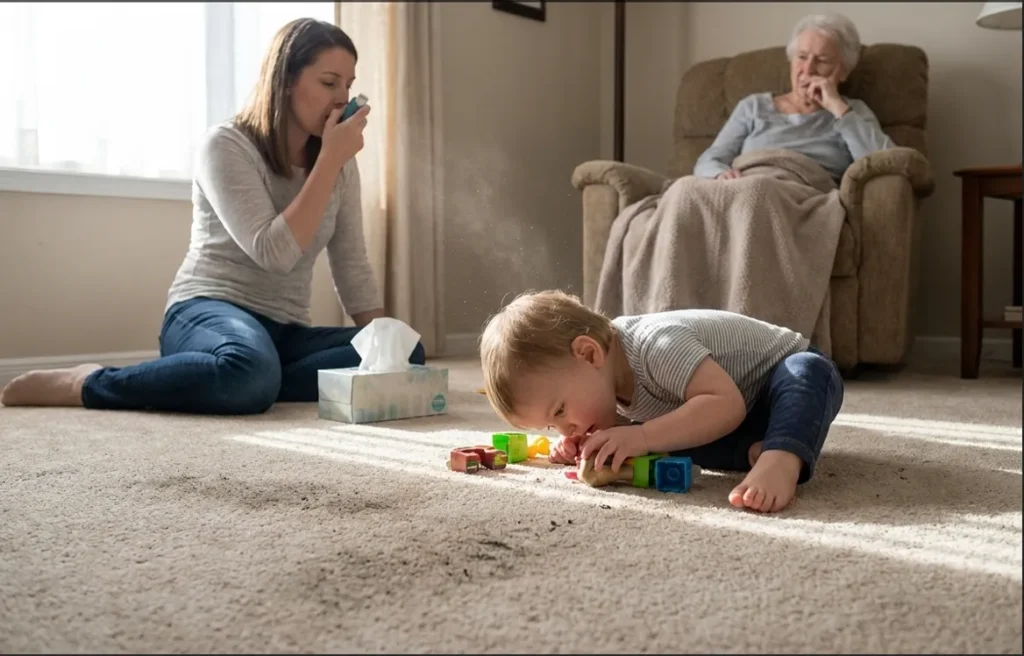
Many people who experience chronic respiratory symptoms at home, including persistent morning congestion, frequent sneezing, itchy or watery eyes, difficulty breathing during sleep, and recurring respiratory infections, correctly attribute them to indoor allergens but incorrectly assume there is little they can do without removing the carpet entirely.
The relationship between carpet condition and symptom severity is well-documented and importantly, it is modifiable. A study from the School of Public Health at the University of California found that homes with regularly cleaned carpets showed significantly lower concentrations of common indoor allergens than comparable homes with the same carpet fiber types maintained on an infrequent cleaning schedule. The carpet type mattered less than the cleaning frequency and method.
Symptoms that improve noticeably when a household member spends time away from home and worsen upon return are a strong clinical indicator that the home environment, including carpet condition, is contributing to ongoing respiratory irritation. Allergists and pulmonologists routinely use this pattern of symptom geography as a diagnostic clue pointing toward indoor environmental triggers.
What Standard Vacuuming Does and Does Not Remove
Routine vacuuming is the foundation of carpet care and maintenance, but its capabilities are frequently overestimated by homeowners who rely on it as their sole maintenance strategy.
A quality upright or canister vacuum with a HEPA filter removes surface soil, larger particulate, and a significant portion of loose allergens from the upper two thirds of carpet pile effectively. Regular vacuuming, meaning two to three times per week in high-traffic areas, captures allergens and particulate before they migrate downward into the lower pile where they become much harder to remove.
What vacuuming does not accomplish is equally important to understand. Standard vacuuming does not effectively remove dust mite allergens, which are held electrostatically to carpet fibers and resist suction-only removal. It does not remove allergens embedded in the lower pile and carpet backing. It does not address mold or bacterial growth within the carpet structure. It does not remove VOCs absorbed into the fiber. And vacuums without true HEPA filtration, particularly older bagless models with standard filters, can actually worsen air quality by capturing larger particles while allowing fine PM2.5 particles to pass through the exhaust and become airborne.
The HEPA standard, which captures 99.97 percent of particles at 0.3 microns and larger, is the relevant benchmark for carpet vacuum filtration in a household where air quality is a priority. Brands including Miele, Dyson, and Shark offer HEPA-sealed systems that meet this standard across various price points.
How Professional Hot Water Extraction Improves Indoor Air Quality
Professional carpet cleaning using hot water extraction, the method recommended by the Carpet and Rug Institute (CRI) as the most effective residential cleaning technique, addresses the air quality limitations of vacuuming by reaching deeper into the carpet structure and removing categories of contamination that surface cleaning cannot touch.
The hot water extraction process injects heated water combined with a cleaning solution deep into the carpet pile at high pressure, loosening and suspending embedded soil, allergens, and biological material. The powerful extraction phase then removes the loosened contamination along with the water, pulling material from deep within the pile and backing that has accumulated over months or years.
Independent testing commissioned by the CRI and conducted by third-party laboratories has documented that properly executed hot water extraction removes the majority of dust mite allergens, pet dander, and embedded particulate from carpet, producing measurable improvements in indoor allergen levels that persist for weeks to months following professional cleaning.
Truck-mounted hot water extraction systems, which generate significantly higher water temperatures and extraction power than portable units, produce the most thorough results. The higher temperature also denatures biological allergens including dust mite proteins and some mold spores more effectively than lower-temperature portable systems. For households where air quality is a health priority, specifically requesting truck-mounted carpet cleaning in San Angelo rather than portable equipment is an important distinction when hiring a professional carpet cleaner.
The frequency of professional cleaning that produces meaningful air quality benefits depends on household conditions. The CRI recommends professional cleaning every 12 to 18 months under standard conditions. Homes with pets, allergy sufferers, or young children benefit from a more frequent schedule of every 6 to 12 months.
Schedule a Truck-Mounted Deep Clean — Free Quote
The Role of Carpet Padding in Indoor Air Quality
Carpet padding is the hidden component of the carpet system that most homeowners never see and rarely consider in discussions of indoor air quality, yet it plays a significant role in the overall contamination picture.
Carpet padding acts as a secondary reservoir for everything that migrates through the carpet above it: moisture, biological material, dust mite populations, mold spores, and chemical residues. Because padding is never directly cleaned during routine vacuuming and is reached only partially even during professional hot water extraction, contaminants that reach the padding level tend to accumulate over the life of the carpet without being removed.
In situations where moisture has reached the padding, whether from spills, flooding, high humidity, or cleaning processes that over-wet the carpet, mold growth in the padding can be extensive while the carpet surface above shows little visible indication. Mold in carpet padding releases spores continuously into the air above, creating a persistent air quality problem that professional cleaning of the carpet alone does not resolve.
When carpet with known moisture history or a musty odor is professionally cleaned without improvement in the odor, padding replacement rather than continued carpet cleaning is typically the appropriate next step. The Institute of Inspection, Cleaning and Restoration Certification (IICRC) S100 standard for carpet cleaning addresses this scenario specifically, recommending padding assessment and replacement when moisture damage is suspected.
Practical Steps to Improve Indoor Air Quality Through Carpet Care
Understanding the problem is useful; having a clear action plan is what actually improves the air in your home. Here are the most impactful interventions organized by immediacy and effort.
Increase Vacuuming Frequency and Upgrade Equipment if Needed
The single most accessible improvement for most households is simply vacuuming more frequently with better equipment. Three times per week in high-traffic areas and weekly in lower-traffic rooms, using a HEPA-sealed vacuum, removes allergens from the breathing zone before they migrate to depths where only professional extraction can reach them. If your current vacuum is more than five years old, does not have HEPA filtration, or leaves visible debris behind after a pass, replacing it is one of the highest return-on-investment upgrades available for indoor air quality.
Manage Entry Points to Reduce Contamination at the Source
High-quality doormats at every exterior entry point, combined with a consistent shoe-removal habit, reduce the volume of outdoor contaminants reaching carpet by a substantial margin. Lawrence Berkeley National Laboratory research has documented that shoe removal at the door is among the most effective single behavioral interventions for reducing tracked-in pesticide and heavy metal contamination in residential carpet.
Control Indoor Humidity
Dust mite populations thrive at relative humidity levels above 50 percent and are largely unable to sustain themselves below 35 percent. Maintaining indoor humidity between 35 and 50 percent using a dehumidifier in humid climates or a whole-home humidification system in dry climates keeps dust mite populations at levels that produce significantly lower allergen concentrations in carpet. The EPA recommends maintaining indoor humidity below 60 percent as a baseline measure for mold prevention, with lower levels preferable for allergen control.
Schedule Professional Cleaning at Appropriate Intervals
For households with allergy sufferers, asthma, pets, or young children, professional carpet cleaning every six to nine months produces measurable and sustained indoor air quality improvements. Requesting truck-mounted equipment and asking whether allergen-reducing pre-treatment rinses are available from your cleaning provider further improves outcomes. If you also have upholstered furniture in the home, pairing carpet cleaning with upholstery cleaning in the same visit addresses both major allergen reservoirs in your home simultaneously.
Address Spills and Moisture Immediately
Every moisture event in carpet that is not addressed promptly within 24 to 48 hours creates conditions for mold growth that compounds the air quality problem significantly. Blot spills immediately, extract as much moisture as possible, apply directed airflow from a fan, and use a moisture meter if available to confirm the carpet and padding have reached acceptable dryness before considering the incident resolved.
Improve Your Home’s Air Quality — Book a Cleaning Today
When Carpet Replacement Is the Right Answer for Air Quality
There are circumstances where cleaning, regardless of method or frequency, cannot restore a carpet’s contribution to acceptable indoor air quality, and replacement is the appropriate decision.
Carpet with documented water damage that has been wet for more than 48 hours without professional drying intervention should be considered a mold risk regardless of surface appearance. Carpet that has developed a persistent musty odor that does not improve after professional cleaning is almost certainly harboring contamination in the padding that cleaning cannot address. Carpet that is physically degraded, with broken fiber structure, worn backing, or visible disintegration, has lost its structural capacity to hold allergens in the pile and is releasing them into the air more readily than intact carpet would.
In these situations, removal of both the carpet and the padding, followed by treatment of the subfloor if contamination has reached that level, and installation of new carpet with appropriate padding represents the most meaningful air quality intervention available. The IICRC and the EPA both provide guidance on assessing when remediation crosses the threshold from cleaning to replacement. If you are unsure whether your carpet has crossed that line, a professional carpet inspection in San Angelo is the fastest way to get an honest assessment.
Final Thoughts on Dirty Carpet and Indoor Air Quality
The relationship between carpet condition and indoor air quality is direct, well-documented, and highly actionable. Dirty carpet does not just look and smell unpleasant; it actively degrades the air that every member of your household breathes every day, with consequences that range from mild seasonal allergy-like symptoms to significant respiratory disease exacerbation in vulnerable individuals.
The reassuring reality is that the interventions required to shift carpet from pollution source back to passive filter are neither expensive nor technically complex. Consistent vacuuming with appropriate equipment, source control at entry points, humidity management, professional carpet cleaning in San Angelo at intervals matched to household conditions, and prompt response to moisture events collectively address every major mechanism by which dirty carpet degrades indoor air quality.
Your carpet covers more square footage than any other surface in most homes. Treating its maintenance as a health decision rather than merely an aesthetic one changes both the priority you assign it and the outcomes you achieve from it.